Do.

Lately, a little “game” has been circulating on Facebook, as little games often do. In this “game,” women are supposed to post a status with a heart emoji. Nothing more, nothing less. Ostensibly, the point is for other people to come along and either “like,” comment on, on question the status, and in response, the poster sends a private message saying something about breast cancer. This, my friends — along with buying everything pink under the sun — is, apparently, how we’re going to wipe out breast cancer. Not research. Not prevention education. Not access to care. Little heart emojis and pink ribbons and vague Facebook games that don’t actually mention breast cancer are where it’s at, y’all.

Sounds ridiculous, doesn’t it?

Because it is.

We don’t need more breast cancer awareness on social media. In fact, there might not be a cause that needs us to generate awareness any less. I mean, we’re talking boobs here. Are there many things that get more attention that aren’t censored by most platforms’ nudity clauses? We have to save the ta-tas. Our ability to endlessly debate where many women can feed their children and the entertainment of young people who haven’t discovered porn or ways to circumnavigate the parental controls on their electronic devices are at stake. So we talk about breast cancer. We talk about it endlessly. We play Facebook games and buy pink stuff and wear pink ribbons and post with hashtags and  walk in walks for charities that may or may not do anything but raise awareness we don’t need and sell more pink stuff.

Awareness doesn’t do anything. Action does.

And then we turn around and we talk a little bit about the other stuff. We use a hashtag to express our displeasure with political leaders, we put on safety pins to show the world we aren’t assholes, we wear a puzzle piece and talk about how important neurodiversity is and about how autism really isn’t as bad as death, we ask when enough is going to be enough every time we hear about a young person committing suicide because there are no spaces safe from bullies anymore, and we share phone numbers for hotlines staffed by volunteers and mental health professionals. We endlessly promote awareness of issues while talking about how we need more awareness of issues.

But here’s the thing. Awareness doesn’t do anything. I’ll say it again. Awareness. Does. Not. Do. Anything.

We’ve never been more aware. Never in the history of humankind have we been so aware of different illnesses and conditions, of societal issues, of economic issues, of the 378,921,506 ways we can offend every single person we know and don’t know every single day just by existing.

And, yet, I wonder if we’ve ever been more apathetic.

In 2014, Shonda Rhimes, mastermind of Thursday night television on ABC, gave the commencement speech to the graduates and parents of her alma mater, Dartmouth College. In that speech, she talked about a lot of things and made a lot of good points, but the one I want to highlight here is simple. Get out of your own little world, and do something.

Awareness doesn’t do anything. Action does.

Pick an issue. Just one issue. And do something about it. By the way, if you haven’t figured it out, posting to social media isn’t doing something. It’s okay to do that, of course. We all do, and we probably always will. I’m certainly just as guilty of it as most other people. I may tend to live my life within the walls of my house, venturing out only when my introverted, anxious self is forced to buy milk at the last minute or take one of my kids to an appointment, but I feel strongly about things, and because I do feel so strongly, I tend to compose scathing rants and impassioned calls to action. I’m good at it. Heck, I’m doing it right now. But at the end of the day, it’s talking. And while I obviously love talking, and you aren’t likely to get me to shut up any time soon, talking is not doing. It has its place and purpose. But it’s not doing.

So, no, I’m not good at going out and confronting the world. But I must change. We all must change. We must do. We must contact our leaders when we don’t approve of how they are representing our voices, speak up when we see others being torn down, and literally stand beside a person being persecuted. We must listen and take action when our teachers tell us current policies are preventing them from teaching their diverse student bodies effectively; believe the child who says he is being bullied and take action beyond words; volunteer in after school programs, youth centers, and homeless shelters; and support funding for better access to mental health resources. We must hand out food and blankets to homeless people on the streets, volunteer at a clinic, build houses for low income or homeless families, and donate the money we spend on walks and races and “awareness” to organizations that put the money in the hands of the people doing the real work of research and helping those who need it. We must find the thing we’re passionate about, our talent, or the thing we believe in and use it to make a difference, big or small. There are a billion ways to make a difference for a million causes. Pick one.  And do.
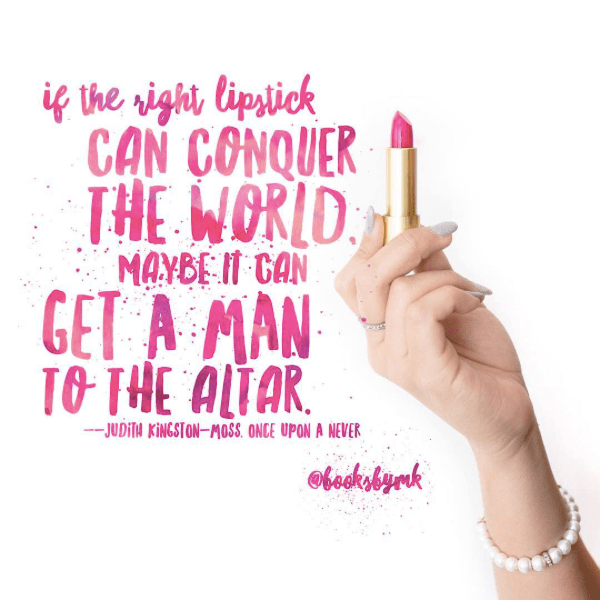
The Right Lipstick…

I don’t know how every other writer writes. We all have our own processes. But two things are almost universally true.

  1. Every book — every story — goes through multiple drafts.
  2. Every writer has to kill a baby.

Don’t panic. Writers aren’t going around killing cute, squishy babies. Well, some might be. I mean, it’s not like I know every writer out there, and it’s not unreasonable to assume that a few might be, well, murderously psychotic or something. But it’s not a general rule. No one pulls writers aside and says things like, “So, you want to be a writer, eh? Well, here’s your axe.” Wow, this has really gone off course. Moving along…

My point. Writers aren’t murdering babies. But they are murdering their babies, as in their literary babies, i.e. their words. Every day, hundreds or thousands of writers are sitting down and swiping their little red pens (either proverbial or literal) across moments they adore. Across words that made their hearts flutter or their palms sweat or their bodies tense in fear or laughter ring out from their lips. Maybe it’s a piece of dialogue that shows a different side of a character. Maybe it’s a turn of phrase the writer is particularly proud of. Maybe it’s a rare opportunity to use a favorite word (“syzygy,” anyone?). It could be anything. But the author thinks, “I hope that one stays.”

screen-shot-2017-01-06-at-9-45-24-pm

Right now, I’m working on the second draft of a contemporary romance that has been floating around in my head for years. I’ve lost count of how many things have changed. I can count on one hand the moments that are set in stone. I’ve shared them with a few friends. You’re going to love them. I promise. But there are also several tidbits I do love but that are, ultimately, up for grabs. Including the title (mostly because I’m liking that for another idea that popped into my head earlier today).

One of those moments is this little piece of dialogue from my protagonist’s mother, Judith Kingston-Moss. In the middle of a crisis, with her daughter’s world falling apart, she’s trying to adjust her daughter’s makeup. Exasperated, her daughter bats her away, questioning why on Earth she should care about something so trivial, and Judith quips, “Well, if the right lipstick can conquer the world, maybe it can get a man to the altar.” It’s not very consequential to the story. It’s not particularly revealing of the character. Judith, as you’ll discover, is more than meets the eye. But it’s just such a Judith thing to say. And for that reason, I hope it stays.

The Clock Exercise

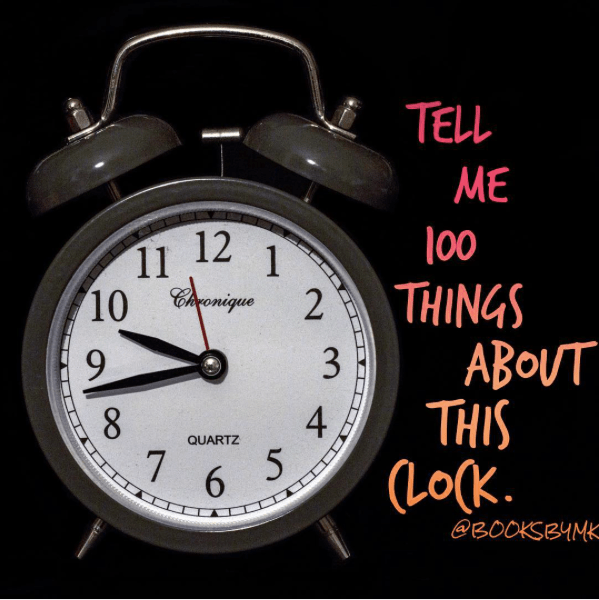
During my Freshman year of college, I was sitting in my first creative writing class when the professor told us to pull out our pencils and notebooks. (Because it was 1996, and we still kicked it old-school back then. Yes, I’m old. Ish.) He told us to look at the clock on the wall above the chalkboard. (Old, remember?) It was a standard classroom clock, the kind that had been hanging in every classroom in which I’d been taught since kindergarten. Black rim, white face, black numbers and minute marks, black hands with a red second hand that tick, tick, ticked. Nothing remarkable about it. But he wanted us to list 100 things about it. One hundred ways to describe a standard classroom clock we’d all seen a thousand times.

It was an exercise in observation, and it was a good one. It taught us to look beyond the obvious and get down to the nitty gritty details. It was also woefully incomplete, at least for any writer hoping to remove beyond Creative Writing 101. Why? Because it isn’t enough to know how to describe your clock. You have to know what makes your clock tick.

Writers describe clocks all the time. Their characters are clocks who are wearing clocks, living in clocks within clocks, interacting with clocks, desiring clocks, and hiding from clocks. A clock can be anything. It’s a character, clothing, setting, world, relationship, desire, goal, complication, or one of a million other things. And the writer knows everything there is to know about it. (Or at least enough to make it seem that way.) Writers can describe clocks for thousands of pages — but if they do, they’ll never get around to telling the story.

It isn’t enough to know how to describe your clock. You have to know what makes your clock tick.

They have to know what makes the clock tick. They have to know how to separate the significant from the insignificant.

Time for a writing exercise.

1. List 100 descriptors for this clock. Yes, you’re going to have to get down to the nitty gritty details. That’s the point.

2. Decide what you’d really want to convey about this clock to someone who has never seen it – or maybe even any clock at all.

3. Determine which descriptors convey that message. Hint: It won’t be all of them. That’s the point.

Master that, and you’ve mastered the clock.

~Melanie

The Backpack

When Little Dude started 2nd grade this year & wanted to use the same backpack he’d been using since kindergarten, I was concerned. With its light blue background and assortment of colorful airplanes, trains, and trucks, it was adorable, but it also skewed younger than the comic book heroes and science- or sports-oriented themes so many boys his age seemed to favor. And, frankly, I was afraid that second grade would be the year other kids would make fun of him for what they deemed a “babyish” pattern.

I’m always afraid of such things. That’s part of being a mom, but more so, I think it’s part of being an autism mom. A mom to a kid with interests and tastes that don’t always match up with his peers. A mom to a kid who, mercifully, doesn’t always understand when other people aren’t being nice but who, every so often, does understand it with heartbreaking clarity. So, when my little guy rebuffed my offers to buy his new backpack in a different pattern, I did what any self-respecting mom would do. I resorted to begging.”Please, baby,” (because calling your kid “baby” is the most effective way to get him to feel like a big kid?) I said, “you know I’ll let you use whichever backpack you want. But are you going to be okay if another kid tells you it’s silly?”

“It doesn’t matter if other kids like it, Mama. It makes me happy.”

Those words stopped me. Yes, I still bought two other backpacks in more “big kid” themes, but I didn’t beg him to use them. Why should I? His backpack was his backpack, he liked it, and that was enough. The spare backpacks were simply there in case the day came when liking his current one wasn’t enough. Because that’s what moms do. We prepare.

But halfway through the school year, those two spare backpacks are still in the closet. One — the Minecraft one — was carried once. The last day of school before break required a lot of “stuff” in the form of gifts for teachers, a stuffed animal and blanket for a party, and sneakers to be worn when he changed out of his snow boots, and the extra space in the Minecraft backpack came in handy. If a kid has commented on the usual backpack, Little Dude hasn’t mentioned it. I even stopped asking him each Sunday evening which backpack he wanted me to pack for Monday morning. The answer is trains. It’s always trains. And that’s okay.

And in the end, I haven’t just learned that maybe kids aren’t quite as cruel as I thought or that maybe my kid is a little tougher than I realize. I’ve learned that we should all have a little backpack with colorful planes, trains, and trucks. We all have that thing that brings us joy but that we hide a little because we’re afraid people will judge it. I see it every day. Women who think they can’t wear boldly printed leggings because they’re too old. Men who don’t want to admit that they get sucked into the world of “My Little Pony.” Readers who detest almost everything critics adore but can — and will — read over fifty romance or science fiction novels per year. Authors who have written multiple books but don’t think of themselves as real authors because those books aren’t on the shelves at B&N. Writers who have been told over and over that they aren’t really writers because they don’t sit down every day and write. And, really, why should we care? Why shouldn’t we just do our thing? Because if it makes us happy — and doesn’t hurt others — isn’t that what matters? My Little Dude thinks so. I think so.

And by the way, if you’re wondering… my backpack? I have a few. Bold printed leggings, sappy rom-com movies, romance novels (especially historical romance), and teen drama on TV. What’s yours?

January 2017 Reading Challenge

Each year, I try — and the operative word is, indeed, “try” — to read an average of one novel each week. I don’t always manage it. Sometimes, I get caught up in writing. Other times, I get busy. Still others, I spend a little bit too much time binge watching something on Netflix or Amazon Prime. But I try.

Most years, I find a list of categories, bulk it up with my own ideas, and map out my entire year. The problem? Inevitably, a favorite author releases a book I didn’t work into my plan or a book not on my list catches my eye or I start craving a re-read of an old favorite (which leads to another and another), and it all falls apart.

This year, I’ll be doing something different. Instead of operating from a large list and locking in my choices months in advance, I’ll be choosing a few categories each month. Naturally, if I fall behind, I’ll choose fewer categories the following month in the hopes of catching up.

screen-shot-2017-01-10-at-3-17-14-pm

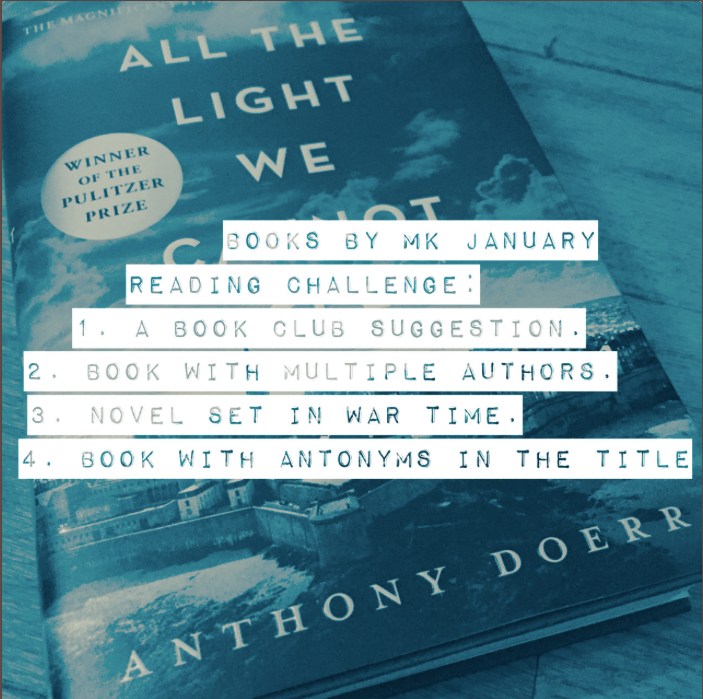
For January, I’ve chosen to read the following:

  1. Book Club Suggestion: “Year of Yes” by Shonda Rhimes
  2. Book with Multiple Authors: “Four Weddings and a Sixpence” by Julia Quinn, Elizabeth Boyle, Laura Lee Guhrke, Stefanie Sloane
  3. Novel Set in War Time: “All the Light We Cannot See” by Anthony Doerr
  4. Book with Antonyms in the Title: “The Truth and Other Lies” by Sascha Arango

As I read, I’ll be sharing my favorite quotes from and my thoughts on my selections. And if you’re reading along with me, I hope you’ll do the same.

The Dice Method for Prompted Writing

dicemethodAt 9 years old, after 4 years of piano lessons, I got a new teacher. Her name was Mrs. Hicks, she kept a dish of hard candy on her piano, she had the brightest red hair I’d ever seen (until I began to rival it myself), she was the nicest lady you’d ever meet, and she was terrifying. On my first day with her, she took a cursory look at my books, had me play the piece I’d been working on with my previous teacher, and walked out of the room. When she returned, she thrust a piece of sheet music into my hands — “The Rose,” as I recall — and said, “You will be play this. It will be difficult, and you will not like it — or me, at times — but you will play it and be better for it. But first, you will play these.”  And she placed three more books on the bench beside me.

I spent the next hour stumbling through exercise after exercise, my fingers tangling through combinations they’d never played, my brain making sense of more symbols than it was used to. When my mom picked me up, I slumped down in the seat of the car, crossed my arms, and proclaimed I no longer wanted to play the piano. I didn’t need silly exercises, I said. I just needed to play. It had been working for 4 years. Why change it?

My mom, of course, laughed — which is exactly what I did the first time someone said to me, in complete shock, “What do you mean you never use writing prompts? How do you practice?”

“Well,” I replied, “I just write.”

The truth was, though the concept of practice to hone a craft wasn’t foreign to me — my first major in college was piano, after all — it had never occurred to me to practice writing. I mean, wasn’t that what first, second, third, and tenth drafts were for? So I laughed it off… until I woke up in the wee hours of one morning, absolutely panicked that I hadn’t added an idea to my trusty notebook in over 2 years. Until I realized that I’d been writing the same ideas over and over and over. Until I got stuck in the middle of a National Novel Writing Month event without a clue what my characters could do that wouldn’t make even me fall asleep. Enter a prompt. And my writing world changed.

The problem many writers have with devoting time to prompts is that they often take precious writing time away from current projects. Away from the projects we want to send out into the world to mark our place in it. But the truth is, if we want to leave a legacy of words worth reading, we have to practice. Just as I had to stretch my fingers and my brain to eventually master “The Rose” — which I did in about 6 months — we, as writers, have to get out of our comfort zones, stretch our imaginations, and hone our skills. That’s where prompts come in.

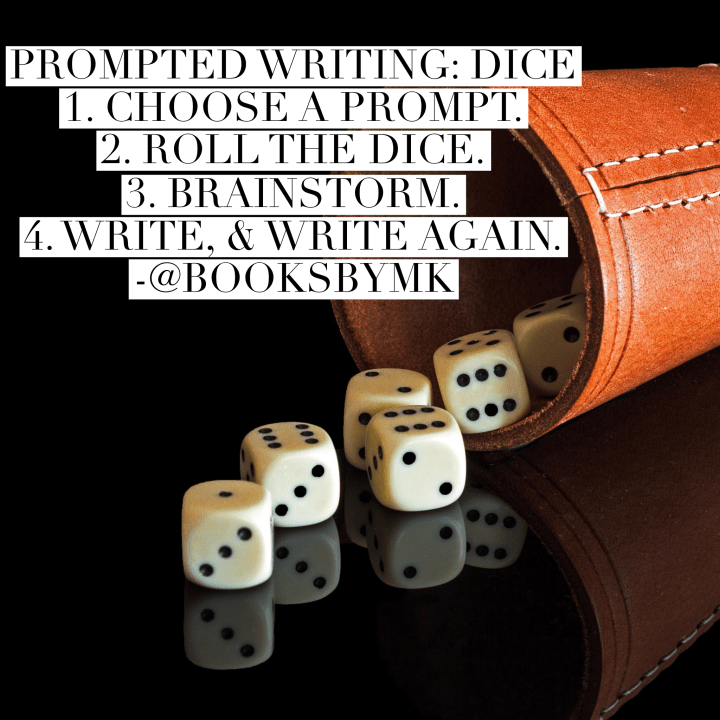
But how do you actually use a prompt? Do you just pick a little piece of inspiration and start writing? Maybe. But personally, to challenge myself and get the most out of whatever prompt I choose, I like to use what I call The Dice Method (creative, eh?).

For this method, you’ll need:
— 2 standard, 6-sided dice (or, if you want to get crazy, grab a couple of multifaceted gaming dice)
— A list of POV styles (e.g., first, second, third, limited, objective, omniscient, etc.) corresponding with each number on one die.
— A list of techniques (e.g., dialogue, exposition, description, etc.) corresponding with each number on one die
— A writing prompt of your choice
— A timer
— Something to write with (i.e., pen, pencil, paper, laptop, etc.)

Okay, you have your materials. Now, it’s time to write.

First, roll the dice. This is how you’ll determine what POV and what technique you’ll be practicing. For instance, using my examples in the equipment list above, rolling a 3 and a 1 would mean you’ll be concentrating on dialogue (technique) in third person (POV).

Now, set your timer because it’s time to brainstorm. In my opinion, one of the easiest ways to do yourself a disservice when working with prompts is to take the obvious path. Why? Because that’s going to be the comfortable path, and you’re trying to step out of your comfort zone. So, set your timer. Personally, I like 15 minutes, but the amount of time is really up to you. While your timer is ticking down, think. Jot down ideas. Anything goes. Maybe an unwanted inheritance is mentioned in your prompt. If your first thought is a cursed object, jot it down, but keep going. Don’t stop until the timer goes off.

Now that you’ve jotted down your ideas, look at your list. Remember that cursed object? It’s nice, but it’s your comfort zone. What else do you have? Maybe your protagonist has inherited a disease, maybe she’s inherited a house in a remote location where she’d never want to live, maybe he’s inherited “the short gene” and can’t get his crush to notice him. Find the idea that’s furthest from your comfort zone but still something you might be able to run with. That’s the one you want.

Now, it’s time to write. Compose a loose outline, make detailed notes, wing it. The choice is yours. Just remember to stay in your POV and concentrate on the technique you’ve rolled. If you’ve placed added constraints on yourself — such as a word count range or the use of a particular plot device — keep those in mind, as well. And once you have your first draft, do what you’d do with any other piece: revise it.

When you have a finished product, congratulate yourself on your strengths, and make note of your weaknesses. Then pick a new prompt, do it all over again, and do it often — because just like I needed practice to master “The Rose” and become a better pianist, we all need to practice and master a myriad of skills to become better writers.

Happy writing!
Melanie